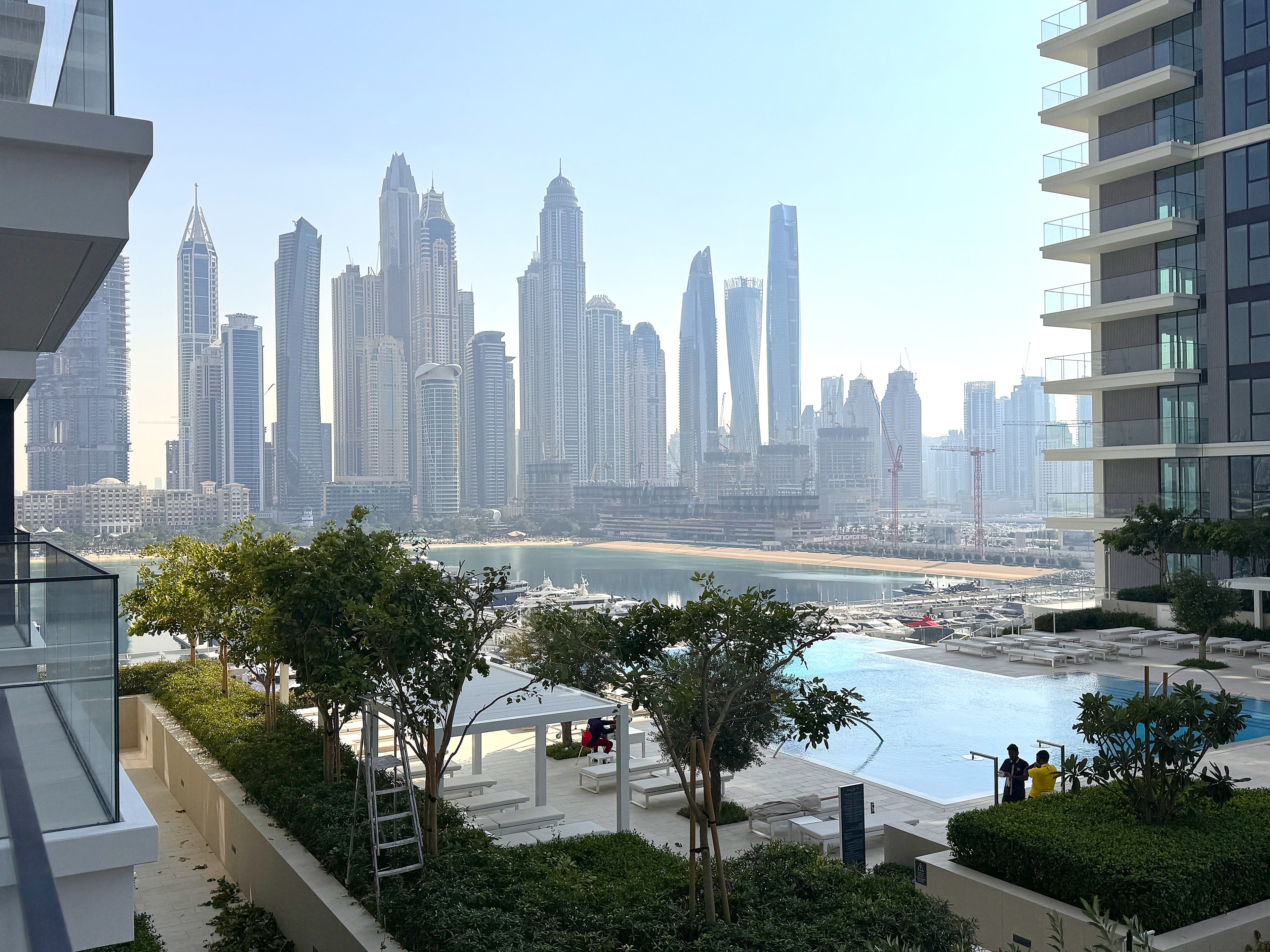
Dubai's property market entered 2026 with the strongest quarterly performance in its history. Then the region shifted. Geopolitical tensions tested investor sentiment in March, equity markets fell sharply, and a brief but meaningful slowdown followed. And yet the transaction data, the capital flows, and the on-the-ground picture tell a more nuanced story than any headline can.
This is the full picture for Q2 2026. The numbers, the context, what actually happened in March, what the ceasefire means for the market, and where the real opportunities sit right now.
Q1 2026: The Strongest Quarter in Dubai Real Estate History
Before March complicated the picture, the first two months of 2026 set records that nobody in the market expected to see this early in the year.
The headline numbers
According to official data released by the Dubai Land Department, Q1 2026 produced the following:
• Total transactions: AED 252 billion — a 31% year-on-year increase in value
• Transaction volume: 60,303 deals — up 6% from Q1 2025
• Total investor base: 48,448 investors, an 8% increase
• New investors entering the market: 29,312, up 14% year-on-year
• Foreign investment value: AED 148.35 billion — a 26% rise
• Luxury real estate investments: AED 87.71 billion — up 26%
These are not incremental improvements on a strong 2025. These are structural signals of a market that has moved into a different tier of global relevance.
January 2026: A month that rewrote every benchmark
January alone recorded AED 72.4 billion in residential sales — the single highest monthly figure in the history of Dubai real estate. Off-plan transactions drove the result, with primary market values up 90% year-on-year in that month alone. Within off-plan specifically, values surged 128% compared to January 2025.
In any other global city, numbers like these would trigger alarm. In Dubai, they reflect a combination of structural supply, global capital flows, and a buyer base that has become genuinely international at scale. Over 150 nationalities participated in the market this quarter.
Off-plan continues to dominate
Off-plan properties accounted for approximately 70% of all transactions and 71% of total value in Q1 2026. This dominance is not new, but the depth of it is. Developer payment plans, zero property tax, and a pipeline of high-quality projects from established names continue to draw investors who are looking for both capital appreciation and entry flexibility.
What Happened in March — And Why It Matters
March 2026 was different. After two months of extraordinary performance, the market slowed — and the reasons were external rather than structural.
The geopolitical backdrop
Regional tensions escalated significantly in the weeks leading into March. Military exchanges between Iran and Israel, the temporary disruption of the Strait of Hormuz, and heightened security protocols across the Gulf region created a sharp adjustment in investor sentiment. Dubai's stock market index fell approximately 16% from its late February levels. Aviation disruption led to over 18,000 cancelled flights. Around $120 billion was erased from UAE equity markets in roughly a month.
This environment produced a predictable, and historically familiar, response: investors paused rather than proceeded.
What the transaction data actually shows
March sales reached AED 43 billion, down from AED 47.3 billion in March 2025 — a 6.4% year-on-year decline. Transaction volumes fell 18% quarter-on-quarter. On the surface, this looks like a correction. In context, it looks like a temporary interruption in an otherwise strong trajectory.
The full Q1 picture remained firmly positive: total Q1 2026 sales value was 24% higher than Q1 2025, and volume showed a marginal increase. The March dip compressed what was otherwise the strongest quarter ever recorded.
What the brokers are actually seeing
Industry sources across the market confirm that the slowdown in March was driven by sentiment, not fundamentals. Most transactions were not cancelled — they were postponed. Buyers were waiting for clarity, not walking away. C-grade developers responded by offering direct discounts. B-grade players made payment plans more investor-friendly. Premium developers largely held pricing, waiting for sentiment to stabilise rather than capitulating on terms.
The luxury and ultra-prime segment showed particular resilience. In January alone, 990 homes priced above AED 10 million were sold. High-net-worth buyers have historically been less sensitive to short-term geopolitical noise, and the March data bears this out.
The US-Iran Ceasefire and What It Means for Dubai Property
On April 7, 2026, President Donald Trump announced a two-week ceasefire with Iran, brokered through negotiations facilitated by Pakistani Prime Minister Shehbaz Sharif. The announcement was immediate in its market impact.
Oil prices dropped over 13%. Global equity markets rallied. And in Dubai's real estate market, the accumulated demand that had been sitting on hold through March and early April began to move.
The pattern Dubai investors already know
Dubai's property market has faced regional disruptions before. The Gulf War, the post-2008 correction, the COVID-19 shock, and multiple earlier Iran-related escalations have all produced temporary pauses in activity. None of them produced a sustained, structural decline. The pattern is consistent: the market slows, it absorbs the shock, it recovers, and it typically surpasses its pre-crisis levels within 6 to 18 months.
The current situation has followed the same shape. The difference in 2026 is the speed of the recovery setup. The ceasefire announcement arrived while the underlying Q1 data was already showing record fundamentals. The pent-up demand created by the March pause is now releasing into a market that did not actually deteriorate — it only paused.
Where the risk remains
Honesty requires acknowledging that not every segment of the market sits in the same position. The areas most exposed to continued uncertainty are:
• Off-plan in remote or emerging locations — these depend more on expectations than established liquidity, and a prolonged conflict could produce corrections of 10 to 15% in this segment
• Mid-market and mass-market projects — where competition is driven by price and payment terms rather than uniqueness, and the incoming supply pipeline of over 210,000 new units in 2026 creates additional pressure
• Highly leveraged buyers — the broader interest rate and liquidity environment has tightened, which affects affordability calculations in mortgage-dependent segments
Prime locations, waterfront developments, and projects from established developers with strong delivery track records have shown significantly more resilience throughout this period.
The Structural Case for Dubai Property in 2026
Beyond the quarterly fluctuations and the geopolitical headlines, the fundamental case for Dubai real estate in 2026 remains intact. It is built on factors that do not move with sentiment.
Population and demand
Dubai's population has crossed 4 million and continues to grow at a rate of approximately 225,000 new residents per year. The UAE's Central Bank projects GDP growth of around 5.6% for 2026, with non-oil sectors acting as a structural buffer against external shocks. This is not a city where demand is speculative — it is backed by a real and growing resident base.
Pricing relative to global peers
At an average of AED 1,676 per square foot, Dubai remains significantly more affordable than London, Hong Kong, Singapore, or Monaco. Apartment rental yields sit at approximately 7%, with villa yields at around 5% — numbers that continue to attract yield-seeking capital from markets where equivalent returns are unavailable. Since the pandemic, average freehold villa values have risen 206%, yet the entry point relative to global alternatives remains compelling.
Regulatory and investor environment
Zero property tax. 100% foreign ownership in designated zones. The Golden Visa threshold at AED 2 million driving consistent demand in that price band. The Dubai Land Department's ongoing pilot of blockchain-based property title integration, which promises faster and more transparent transactions. These are not marketing points — they are structural advantages that continue to attract capital from markets with higher tax burdens, more restrictive ownership rules, or weaker institutional frameworks.
The safe-haven dynamic
There is an apparent paradox in Dubai's current situation: regional instability, and yet capital continues to flow in. The explanation is straightforward. During periods of global uncertainty, investors move toward jurisdictions with regulatory clarity, currency stability, and operational transparency. Dubai consistently scores highly on all three. The UAE dirham's peg to the US dollar eliminates currency risk. The legal framework for foreign ownership is clear and enforced. The infrastructure continues to function.
This is why Dubai attracts capital during regional volatility rather than simply retaining it.
What Smart Investors Are Doing Right Now
The investors who will look back on April 2026 as a defining moment are not waiting for the headlines to fully clear. They are acting on the divergence between sentiment and fundamentals — a gap that historically closes quickly once clarity returns.
Prioritising prime over peripheral
The current environment has accelerated a segmentation that was already underway. Quality communities, waterfront addresses, and well-connected locations are holding value. Remote off-plan projects and oversupplied mid-market areas carry more risk in the near term. The flight to quality is not just a sentiment trend — it is reflected in the transaction data.
Using the secondary market selectively
The short-term sentiment drop has created negotiating opportunities in the secondary market that did not exist in late 2024 or early 2025. In established, liquid communities like JVC and Dubai Marina, macro-driven caution is opening conversations that were not possible at the height of the market. For buyers with capital ready to deploy, this is a window.
Focusing on developer strength in off-plan
For off-plan buyers, the selection criteria have sharpened. Escrow protection, project completion timelines, developer financial position, and track record on previous deliveries are now more important than ever. The market has always rewarded quality over speculation — but that reward differential is wider today than it was twelve months ago.
Planning for the recovery, not just the entry
Historical data from previous regional disruptions suggests a 6 to 18 month recovery cycle following stabilisation. Investors entering or expanding positions in April 2026 are positioning for that recovery rather than trying to time the absolute bottom — a strategy that consistently outperforms the alternative of waiting for full certainty.
Key Data Points to Watch in Q2 2026
As the market moves through April and into summer, these are the indicators that will define how the rest of the year shapes up:
• Monthly transaction volumes from DLD — a sustained return to AED 50 billion+ in April will confirm that March was a pause, not a correction
• Developer launch activity — new launches by Tier 1 developers signal confidence in market absorption; delays or withdrawals signal the opposite
• Rental demand and yields — any softening in rental yields would indicate demand-side pressure; sustained 6 to 7% yields confirm underlying fundamentals
• International buyer mix — the proportion of European, Indian, and GCC buyers in April and May data will indicate whether geopolitical hesitancy has translated into actual exit or simply delay
• DFM Real Estate Index recovery — equity market recovery typically leads physical property recovery by 2 to 3 months in previous cycles
The Bottom Line
Dubai's real estate market in April 2026 sits at an inflection point. Q1 produced the strongest quarter in the market's history. March produced a sentiment-driven pause that did not, in the transaction data, constitute a structural correction. The ceasefire has changed the regional tone. Pent-up demand is beginning to release.
The market is not the same as it was in January. But the fundamentals that made January possible — population growth, zero property tax, foreign ownership rights, yield premiums over global alternatives, and a government consistently committed to investor protection — have not changed.
For buyers and investors who have been watching from the sidelines, the question is no longer whether Dubai's story is intact. It is whether the window created by March's pause remains open long enough to act.
Based on every previous cycle this market has produced, that window is measured in weeks, not months.
Interested in how the current market affects your investment plans?
The Arena Properties team works with buyers across Europe and internationally who are navigating the Dubai market at every stage — from first-time investors exploring off-plan to experienced buyers looking to reposition existing portfolios.
Get in touch for a no-obligation conversation about where the market sits and what it means for your specific situation.