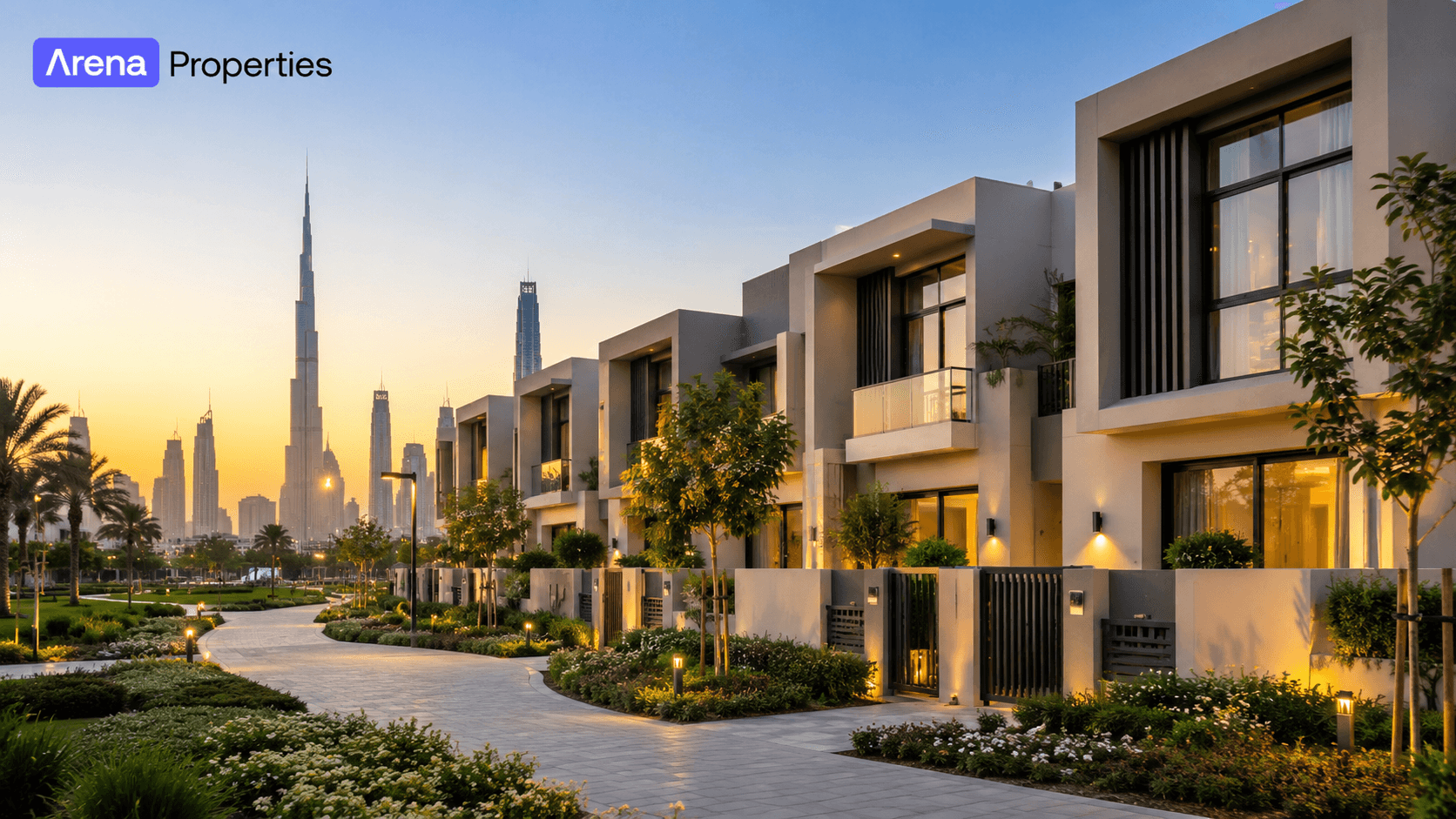
Dubai townhouses for investment can offer an attractive balance between apartment living and the space traditionally associated with villas. They often provide multiple bedrooms, private entrances, outdoor areas, parking, and access to family-oriented communities, while remaining more manageable than larger standalone villas.
For investors, townhouses can appeal to families, professionals, entrepreneurs, and long-term residents who want additional space without moving into the highest segment of the villa market. They may also provide access to developing communities where demand is supported by schools, parks, retail, leisure facilities, and improving infrastructure.
However, a townhouse is not automatically a strong investment simply because it offers more space than an apartment. The quality of the community, property layout, maintenance requirements, rental demand, future supply, and resale potential all influence the final result.
This guide explains how to evaluate Dubai townhouses for investment, including their advantages, differences from villas and apartments, ready and off-plan options, ownership costs, tenant demand, and long-term investment potential.
Quick Answer: Are Townhouses in Dubai a Good Investment?
Townhouses in Dubai can be suitable for investors who want exposure to family demand, community-based living, and properties that offer more space than standard apartments.
They may be especially relevant for investors targeting long-term tenants who value additional bedrooms, private outdoor areas, parking, privacy, and access to community amenities. Townhouses can also provide a more accessible alternative to larger standalone villas in certain residential areas.
The strength of the investment depends on the location, community maturity, property condition, layout, ownership costs, rental demand, and resale outlook. A well-selected townhouse should match both the needs of the target tenant and the investor’s long-term strategy.
Why Investors Consider Townhouses in Dubai
Townhouses occupy a distinctive position within Dubai’s residential market.
They can offer many of the lifestyle advantages associated with villas, including additional space, private entrances, gardens or terraces, and a more residential environment. At the same time, they may involve more manageable purchase and maintenance requirements than larger properties.
This combination can appeal to investors who want to target families and residents planning to remain in Dubai for longer periods. These tenants may value stability, privacy, storage, parking, outdoor space, and access to schools or community facilities.
Townhouses are also available across both established and developing communities. This gives investors the option to choose between properties with existing rental demand and newer developments that may offer future growth potential.
The investment case should still be assessed individually. The success of a townhouse depends not only on the property itself, but also on how well the surrounding community supports everyday living.
Dubai Townhouses for Investment: Key Factors to Review
Before choosing Dubai townhouses for investment, buyers should review the property from several perspectives.
The first factor is the community. Accessibility, road connections, schools, nurseries, parks, retail, healthcare, security, and community maintenance can all influence demand.
The second factor is the layout. The number of bedrooms matters, but so do room proportions, storage, natural light, parking, garden space, privacy, and the relationship between indoor and outdoor areas.
The third factor is the target tenant. Townhouses often attract families, couples requiring additional space, professionals working from home, and long-term residents. The property should be suitable for the audience most active in that community.
Investors should also evaluate ownership costs. Maintenance, landscaping, community fees, repairs, furnishing, vacancy periods, and property management can influence net performance.
Finally, resale potential should be considered from the beginning. The townhouse should remain relevant to future buyers, not only current tenants.
Townhouse vs Villa: Which Is Better for Investors?
Townhouses and villas may attract similar tenant profiles, but they represent different investment options.
A standalone villa may provide more privacy, a larger plot, additional outdoor space, and a more exclusive residential experience. This can appeal to tenants and buyers seeking premium lifestyle value.
A townhouse may offer a more balanced alternative. It can provide multiple bedrooms, private access, parking, and outdoor space while requiring less maintenance and a more manageable investment commitment than a large villa.
The right choice depends on the investor’s budget, target tenant, ownership expectations, and holding period. A villa may support a more premium strategy, while a townhouse may offer access to a wider family-oriented market in certain communities.
Neither option is automatically stronger. The property needs to be evaluated within its specific location and market segment.
Investors considering a larger standalone property can also read our guide on Dubai villas for investment to compare privacy, maintenance requirements, tenant demand, and long-term value.
Townhouse vs Apartment: Different Investment Profiles
Apartments and townhouses serve different tenant needs.
Apartments may be suitable for investors seeking broader demand, central locations, easier management, and access to business or waterfront districts. Studios and one-bedroom apartments often appeal to individuals and couples, while larger units can attract families.
Townhouses generally offer more space, greater privacy, private entrances, parking, and outdoor areas. They may appeal to tenants planning to stay longer or looking for a more settled residential lifestyle.
The ownership responsibilities can also differ. Apartments usually involve service charges connected to shared building facilities, while townhouses may require more direct attention to gardens, exterior areas, and property maintenance.
Investors should not compare the two categories only by purchase price. The target tenant, rental strategy, vacancy risk, maintenance requirements, and future resale audience are equally important.
Buyers looking for broader tenant demand and more manageable ownership requirements can also explore our guide on Dubai apartments for investment.
Ready Townhouses vs Off-Plan Townhouses
Investors can choose between ready and off-plan townhouses.
Ready townhouses provide more certainty before purchase. Buyers can inspect the property, review its condition, understand the community, compare nearby units, and evaluate existing rental demand.
They may suit investors who want to generate rental income sooner or who prefer to base their decision on an established property and community.
Off-plan townhouses can offer access to new developments, modern layouts, staged payment structures, and communities with future growth potential. However, investors need to evaluate the developer, project quality, expected completion, infrastructure, future supply, and demand after handover.
The payment plan should not be the only reason for selecting an off-plan property. The townhouse should offer the right combination of location, design, pricing, tenant appeal, and long-term market potential.
The right choice depends on the investor’s timeline, financial planning, risk tolerance, and investment objective.
For a broader comparison of completed units and properties under development, investors can also read our guide on off-plan or ready property in Dubai.
Community Quality and Family Demand
Community quality plays a central role in townhouse investment.
Families often look beyond the property itself. Schools, nurseries, parks, playgrounds, supermarkets, healthcare, security, road access, and recreational facilities can all influence their decision.
The quality of community management also matters. Landscaping, maintenance, cleanliness, security, shared facilities, and general organization can affect both tenant satisfaction and resale appeal.
An attractive townhouse in a poorly connected or incomplete community may struggle to compete with a more practical property in an established residential environment.
Investors should consider how the community functions during everyday life, not only how it appears in marketing materials. Long-term demand is usually stronger where residents can access the services and amenities they need conveniently.
Rental Demand and Tenant Profile
Townhouses commonly attract families, professionals, business owners, and residents looking for more space than an apartment can provide.
A practical townhouse should offer a layout that supports daily living. Bedrooms, storage, parking, kitchen design, natural light, privacy, outdoor areas, and access to community amenities can all influence rental appeal.
Investors should also understand how long tenants are likely to remain. Family-oriented properties may attract residents looking for greater stability, but this depends on the area, rental level, community quality, and property condition.
Rental expectations should be assessed realistically. Investors need to consider vacancy periods, maintenance, management, community fees, and any upgrades required to keep the property competitive.
Ownership Costs and Maintenance
Townhouses often come with ownership responsibilities that differ from those associated with apartments.
Private gardens, terraces, exterior surfaces, parking areas, larger interiors, and multiple systems may require regular maintenance. Investors should understand which responsibilities belong to the owner and which are covered by the community.
For ready townhouses, the property condition should be reviewed carefully. Air conditioning, plumbing, electrical systems, exterior finishes, doors, windows, landscaping, and previous alterations may all affect future costs.
For off-plan properties, investors should consider handover quality, warranty conditions, future community fees, and the level of maintenance the property may require after occupation.
A property with strong rental demand can still produce a weaker result if maintenance expenses are underestimated. The full ownership picture should therefore be reviewed before purchase.
Layout, Privacy and Outdoor Space
The internal and external design of a townhouse can significantly influence its investment appeal.
A practical layout should make efficient use of the available space. Bedrooms should be appropriately positioned, living areas should support family use, and storage should be sufficient for long-term residents.
Privacy also matters. The distance between properties, garden orientation, entrance position, neighboring units, and surrounding roads can affect how tenants and buyers perceive the property.
Outdoor areas can strengthen demand, particularly for families with children or residents who value private leisure space. However, these areas should be practical and proportionate to the property rather than included only for visual appeal.
Parking, access, natural light, and unit position within the community can also distinguish one townhouse from another.
Resale Potential and Future Supply
Resale potential should be considered before the townhouse is purchased.
A property that appeals to both investors and end-users may offer greater flexibility when the owner decides to sell. Practical layouts, reputable communities, good access, controlled maintenance requirements, and strong family demand can all support resale interest.
Future supply is another important consideration. If many similar townhouses are delivered within the same area, buyers may have more choice and greater negotiating power.
Investors should therefore review not only current availability, but also planned development and how the community may evolve over time.
Investors should also compare their assumptions with verified market information from the Dubai Land Department, including transaction, rental, project, building, and area-level data.
A townhouse with genuine advantages, such as a better position, larger plot, practical layout, stronger privacy, or proximity to amenities, may compete more effectively when additional supply enters the market.
Dubai Townhouses for Foreign Investors
Dubai townhouses for investment can be relevant for international buyers looking for rental income, future relocation, family use, or portfolio diversification.
Foreign investors should consider how the property will be managed if they are not based in Dubai. Maintenance, tenant communication, repairs, inspections, and community-related responsibilities may require reliable local support.
The broader financial position should also be reviewed. Rental strategy, ownership costs, tax residency, currency exposure, and long-term plans can influence whether a townhouse is suitable or not.
International buyers should avoid selecting a property based only on remote presentations or community branding. The townhouse should be compared with similar units, assessed against real demand, and evaluated within the wider market.
The strongest investment decision is based on suitability, not only availability.
Common Mistakes Investors Make
One common mistake is assuming that every townhouse offers the same advantages as a standalone villa. Privacy, plot size, parking, outdoor space, and community density can vary significantly.
Another mistake is focusing only on the number of bedrooms. A property may have sufficient rooms but still offer an inefficient layout, limited storage, weak privacy, or impractical outdoor areas.
Some investors underestimate maintenance responsibilities. Larger interiors, gardens, outdoor areas, and property systems can result in higher maintenance and ownership costs than those typically associated with apartments.
Others select a developing community without reviewing future infrastructure, planned supply, or how long the area may take to mature.
Investors may also rely too heavily on projected rental income. Net performance should be evaluated after realistic ownership costs, vacancy, repairs, management, and market conditions are considered.
How Arena Properties Can Support Investors
Choosing a townhouse in Dubai requires more than comparing the number of bedrooms or the appearance of different properties.
Investors need to understand the community, tenant profile, layout, maintenance requirements, future supply, rental potential, and resale outlook.
Arena Properties can support investors with townhouse selection, community analysis, property comparison, market evaluation, and real estate investment guidance. This helps buyers understand whether a particular property fits their objective and how it compares with other opportunities.
The right townhouse is not always the largest, newest, or most heavily promoted. Its investment value depends on how well the property, community, demand, ownership costs, and long-term strategy work together.
By working with Arena Properties, investors can approach townhouse opportunities with a clear perspective and avoid decisions based only on presentation, payment terms, or urgency.
(FAQ) Frequently Asked Questions about Dubai Townhouses for Investment
Are townhouses in Dubai a good investment?
Townhouses in Dubai can be suitable for investment when the community, layout, tenant demand, ownership costs, property condition, and resale potential align with the investor’s strategy.
Are townhouses in Dubai better than villas for investment?
Townhouses may offer a more manageable alternative to standalone villas, while still providing space, privacy, parking, and outdoor areas. The right choice depends on the budget, target tenant, and long-term objective.
Are townhouses better than apartments for investment in Dubai?
Townhouses and apartments serve different tenant profiles. Apartments may offer broader demand and easier management, while townhouses may attract families and long-term residents looking for additional space.
Should investors choose ready or off-plan townhouses in Dubai?
Ready townhouses offer more certainty and can be inspected before purchase. Off-plan townhouses may provide access to new communities and future growth potential. The decision depends on the investor’s timeline and risk tolerance.
What should investors review before buying a townhouse in Dubai?
Investors should review the community, location, layout, property condition, maintenance requirements, rental demand, future supply, ownership costs, and resale potential.
Can foreign investors buy townhouses in Dubai?
Foreign investors can purchase property in designated areas where foreign ownership is permitted. The decision should still be based on whether the property fits the investor’s financial and long-term objectives.
Dubai townhouses for investment can offer a balanced alternative for investors who want more space and privacy than an apartment while maintaining more manageable ownership requirements than a large standalone villa.
They may appeal to families, professionals, entrepreneurs, and long-term residents who value community facilities, parking, outdoor areas, and a more settled residential environment.
However, the property should be evaluated carefully. Community quality, layout, maintenance, rental demand, ownership costs, future supply, and resale potential can all influence the final result.
With the right analysis and professional guidance, investors can identify Dubai townhouses for investment that align with their objectives and support a structured long-term property strategy.